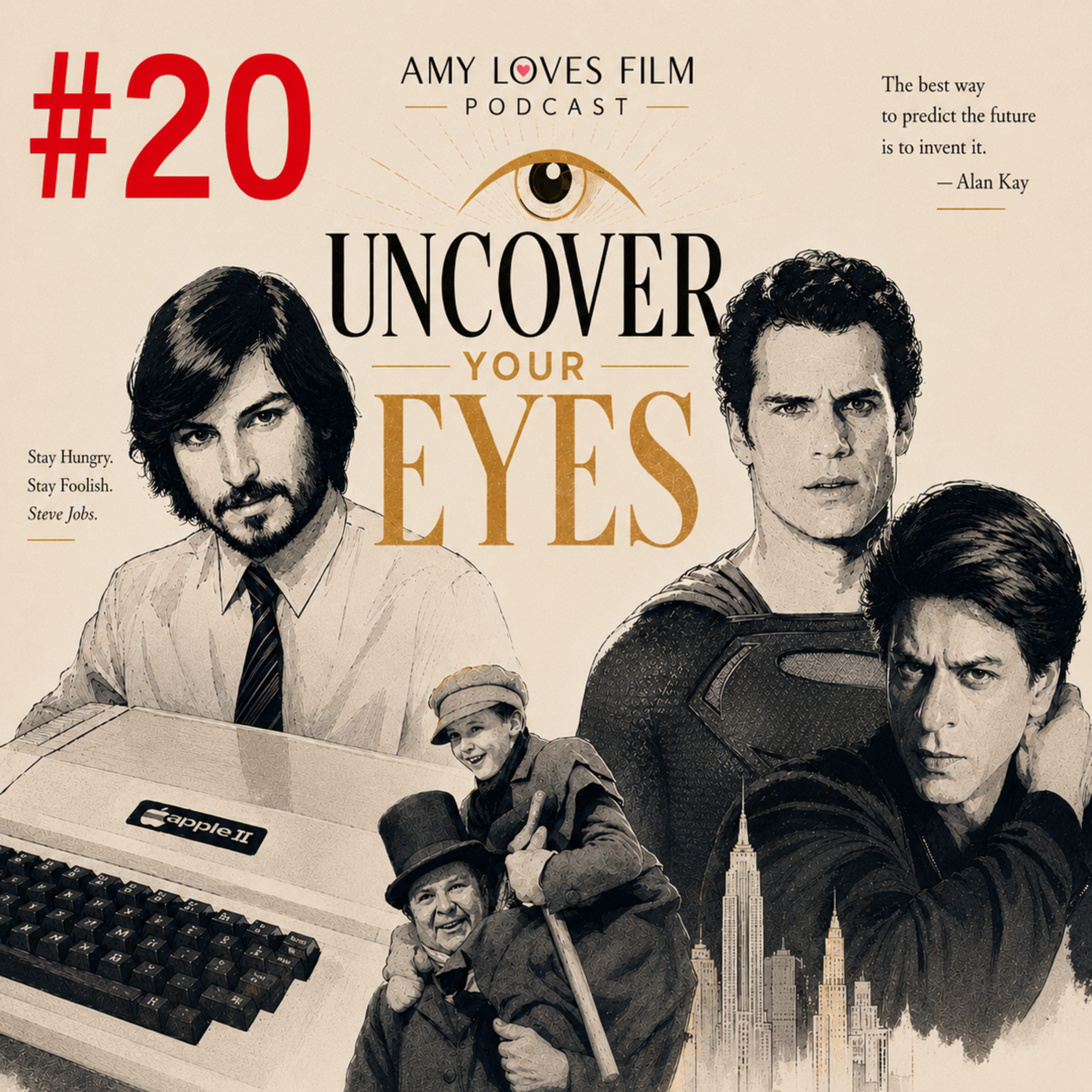
#20- Visionary Leaders in Bollywood | Tesla, Tiny Tim & Chak De! India
About this episode
Uncover Your Eyes explores the psychology of vision, innovation, belief, and the extraordinary power of seeing possibilities before reality catches up. From Nikola Tesla’s astonishing predictions to Tiny Tim’s transformative goodness and Kabir Khan’s relentless leadership in Chak De! India, this episode examines how history’s innovators, thinkers, and unforgettable fictional characters share one hidden trait: they act from a future others cannot yet see.If you love film analysis, Bollywood essays, innovation psychology, storytelling, philosophy, visionary thinking, and deep cinema conversations, this episode is for you.0:00 — IntroductionThe unseen power behind transformative ideas.0:52 — The Nature of Visionary InnovationHow breakthroughs like electricity, space travel, and the internet began as impossible “what ifs.”4:25 — Genius = Persistence?Nikola Tesla, rocketry pioneers, and the discipline of holding an inner vision.6:23 — The Power of IntentTiny Tim (A Christmas Carol) & Kabir Khan (Chak De! India) — two unlikely masters of visionary influence.10:42 — ConclusionHow to cultivate your own ability to see beyond current reality.What possibilities are you refusing to stop believing in?
bollywood leadership chak de india analysis shah rukh khan films visionary storytelling in hindi cinema kabir khan character
So are you superhuman? Hey there. How you doing? Amy again? And I'm sure you can already tell. I'm ready to go. We talked superheroes, but are you superhuman? You can tell me. Do you have something other than me? Not a superpower of sorts to maybe see for example what others cannot. Can you see the unseen like Superman with supervision? Telescopic microscopic X-ray sight. World changing innovation almost always starts as one person's vision of something that does not yet exist and that most people cannot imagine.
That vision, then has to survive doubt, resistance and failure long enough to become reality. Every legendary transformation, whether the light bulb, civil rights movements, Space Flight or the Internet, began this way, as a solitary invisible what if, but only gradually, became everyone else's new normal. Innovators look at the same world as everyone else, but notice a gap, a contradiction, or a new pattern and think it could be otherwise. At this stage, the idea is purely mental. Heavier than air, flight, electric light in every home, personal computers on every desk, a reusable rocket.
All began as images, visualizations, concepts. Someone said that did not match the current world. Because there is no proof yet. Most people naturally treat it as fantasy, impossible or unnecessary. History of innovation is full of this will never work, no one will want this reactions. What separates legendary innovators is not just the idea, but commitment to it before evidence exists. Over time, what was once unimaginable becomes normal and then invisible. People stop seeing the original leap and assume it was always going to happen.
Yet behind every such shift, scientific, technological, artistic, social, there was a moment where it only existed as a vision in someone's mind, an unrealistic belief no one else shared, a possibility that reality had never yet displayed. Because, as Steve Jobs points out, the people who are crazy enough to think they can change the world are the ones who do. Genius, in the historical innovative sense, is often the ability to believe in a coherent future reality that does not yet exist. Visionary figures often describe concrete features of a future world long before the tools exist.
Tesla in the early 1900s predicted a global system. Yes, a wireless communication uh huh, where individuals would carry small devices to access information instantly and connect worldwide, essentially describing smartphones and mobile Internet. Nearly a century, early Russian rocket pioneer Tiziolkovsky worked out the rocket equation and wrote about human spaceflight and permanent space habitats long before any space technology existed. His math and vision laid the conceptual groundwork for modern rocketry.
Yeah, historical genius is not only high intelligence, it is the courage and persistence to treat a well founded inner vision as more authoritative than present appearances long enough for the rest of the world to catch up. Tiny Tim from A Christmas Carol we talked about and Kabir Han from Jagti, India are very different on the surface, right, A frail Victorian child and a tough modern hockey coach. But they are alike in one crucial way. Both have a genius for vision and belief. Each sees goodness and potential, and each believes in a reality that does not yet exist, then lives as if it could be real.
Others see Scrooge as hopelessly mean and the crotch is this pitiable Tiny Tim from within That poverty and sickness still responds with universal goodwill and gratitude, not bitterness. Others see the Indian woman's team as weak, divided by region and unmarketable. Kabir sees grit, talent and the possibility of unity under pressure. In both cases, the majority vision is dismissive, A hopeless miser, a useless team. The genius vision notices something hidden, an unawakened conscience and Scrooge unshaped excellence in the players Kabir trains and disciplines, as if he already has a world class team long before the results or attitude justify it.
He structures practice, selection and strategy around the future version of them that only he currently believes in, or sees for that matter. This is the same pattern as visionary innovation. A mentally real future. A redeemed Scrooge. A champion team. A present that contradicts it. One person stubbornly choosing to trust the inner vision. As Kabir Han says, to build a team, you don't need power or force, You need intent. Tiny Tim and Kabir Han both act from the future, not the present. That consistent stance forces the people around them to either break away or rise to meet the vision.
Both say you are more than what the world currently sees and a better version of you. Us, is real enough that I will stake myself on it. So Tiny Tim and Kmur Hahn are each a visionary of goodness and capability, believing in a reality redeemed hearts, respected women champions that does not yet exist, and helping to make it exist by daring to see it first. I'm not Tiny Tim, I'm no Kabir Han. I'm just a simple girl who loves her some film. But I see, I also see what does not yet exist. Can you see it?
The possibility all around us,
in US.
 Apple Podcasts
 Castbox
 Castro
 Goodpods
 Moon FM
 Overcast
 Pocket Casts
 Podbean
 Podcast Addict
 Podcast Republic
 Spotify
 YouTube