#19- Christmas Caroling Bollywood Edition | American Amy Reacts to Winter Love Stories
About this episode
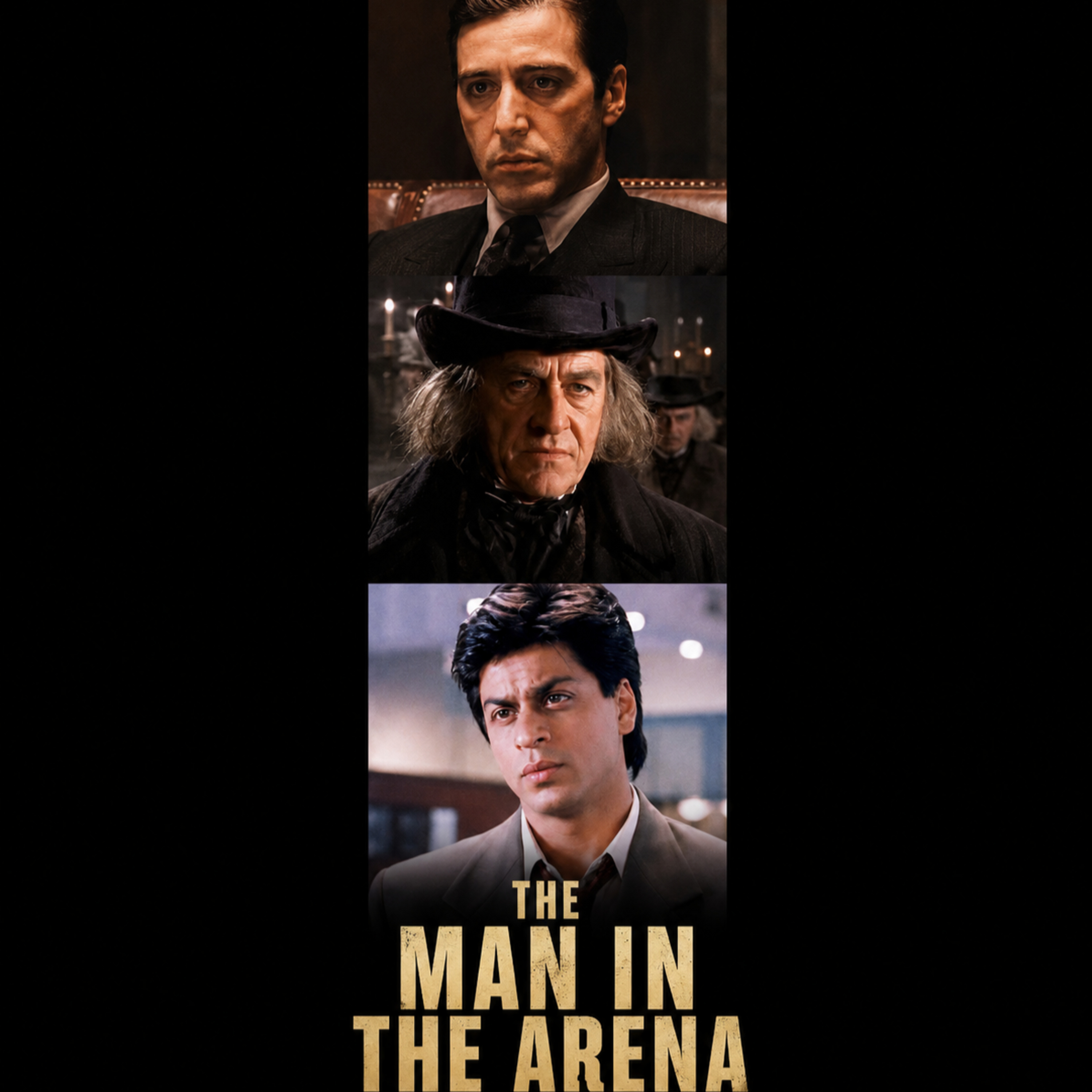
What does Theodore Roosevelt’s “Man in the Arena” speech have to do with The Godfather, Bollywood heroes, and Ebenezer Scrooge?In this video, I explore themes of ambition, vulnerability, moral integrity, courage, and redemption through iconic cinematic characters from Hollywood, Bollywood, and classic literature-inspired film storytelling.Using Theodore Roosevelt’s powerful words... and the ideas of Brené Brown on courage and vulnerability... this discussion examines what it truly means to step into life’s arena… and what happens when ambition outruns conscience.From Michael Corleone’s tragic transformation, to Raju Ban Gaya’s search for meaning, to Scrooge’s powerful moral awakening, this video asks a timeless question:What defines real success?TIMESTAMPS00:00 — Introduction | Entering The ArenaThe connection between cinema, courage, and Theodore Roosevelt’s famous philosophy.00:52 — The Power of “The Man in the Arena”Brené Brown, vulnerability, and why daring greatly matters.02:09 — Theodore Roosevelt’s Message ExplainedWhy the people who struggle, fail, and try again matter more than spectators.04:03 — Cinema’s Ambitious CharactersExploring characters driven by power, achievement, and status.04:35 — Michael Corleone (The Godfather)How a reluctant outsider becomes a powerful leader who loses his moral center.04:48 — #raees Rise and CollapseFrom admired figure to empire builder and the cost of unchecked ambition.05:47 — #raju Ban Gaya GentlemanBollywood’s lesson on ambition, identity, and integrity.05:52 — Ebenezer Scrooge (A Christmas Carol)A deep dive into selfishness, regret, and emotional transformation.09:12 — Why Scrooge’s Story Still MattersThe enduring relevance of empathy, accountability, and human connection.11:36 — Can People Truly Change?The possibility of redemption at any stage of life.11:53 — Redemption Through Self-ConfrontationHow characters face their pasts and choose different futures.14:42 — Redefining SuccessWhy relationships, loyalty, compassion, and character matter more than wealth or approval.15:46 — Tiny Tim: The Overlooked HeroA surprising cinematic connection… and a teaser for the next discussion involving Indian cinema.
bollywood reactions yash Chopra films shah rukh khan films hindi cinema storytelling bollywood romance
Have you guys heard of Britney Brown and her research? Hey friends, where you been? Glad to have you back. Known for her work her research on vulnerability, courage, shame, empathy, and leadership, Brené Brown frequently references Theodore Roosevelt's Man in the Arena quote. Oh it's so good. Y'all know I'm a sucker for a good quote. Have you heard it? Theodore Roosevelt's Man in the Arena quote emphasizing that credits belongs to the person in the arena who strives and bears greatly, rather than the critics on the sidelines.
This quote from Roosevelt's 1910 speech Citizenship in a Republic. Was he still United States president then? No, I don't think so. This quote from his speech in 1910 inspired modern day Brown's work on vulnerability, courage and daring, greatly highlighting the importance of showing up and risking failure to live a wholehearted life. Yeah, I'm right. Can I share? Get your ears ready. I hope your ears are hungry. I got you a treat with this one. All right, here we go. It is not the critic who counts, not the man who points out how the strong man stumbles or where the doer of deeds could have done them better.
The credit belongs to the man who is actually in the arena, whose face is marred by dust and sweat and blood, who strives valiantly, who airs, who comes short again and again because there is no effort without error and shortcoming. But who does actually strive to do the deeds? Who knows great enthusiasms, the great devotions, who spends himself in a worthy cause, who at best knows in the end the triumph of high achievement, and who, at worst, if he fails, at least fails while daring greatly?
Like, Are you there? Dang, if that doesn't hit you right between the eyes, I don't know what will. Boom. So what made me think of this now? Well, what we have been talking about, the man who was actually in the arena, striving, working, hurting, failing, dirty, struggling, getting back up again and again, who at best knows in the end the triumph of high achievement, and who at the worst, if he fails, at least fails while daring greatly. The Godfather. Rice. Michael transforms from a reluctant outsider to a cold on, while Rice shifts from a local Robin Hood figure to someone whose empire causes collateral damage.
Michael Gaines absolute power but loses his moral center and personal happiness, while raises rise ends in betrayal and doom. Despicable by his intention to uplift his community, ambitious men whose rise forces the choice between success and conscience, Michael sinks into ruthless power, Rais into tragic guilt. Michael and Rais show how love or ideals can be twisted by power. What about Raju from Raju Bungaya? Gentlemen, what about Ebenezer Scrooge from A Christmas Carol? A book, a play, many films shown and performed and watched this time of year now originally written in 1843, Where do we begin?
Well, let's think, Where do they begin exactly? Michael from The Godfather starts as a decent war hero who wants a normal life away from the mafia, explicitly distancing himself from his family's criminality. Ra'is begins as a poor, the sharp boy in a dry state doing small smuggling jobs and believing his work is survival that should never hurt the poor in his area. Raju arrives in Mumbai, then Bombay as an idealistic young engineer, hungry for success and status but still basically honest and rooted in small town middle class values.
Scrooge, a rich, cold hearted miser who hates Christmas, hoards money, underpays his clerk and dismisses charity as humbug, which is pointless trickery nonsense. Basically, Michael turns money and power into tools to protect and dominate the family, as they call he calls it. I can't do it quite right, but he basically starts prioritizing control over love relationships, Kay. His siblings become expendable, non essential, easily sacrifice for the empire. Rais treats money and power as ways to lift his people and prove his worth.
But his empire traps him in deals with politicians and gangsters that ultimately hurt the very people he wants to protect.
Raju initially seized success and elite acceptance as the sign of having become a gentleman, then learns that chasing status without integrity destroys trust, love, and ordinary people's safety. Scrooge begins by valuing money over human connection, but ends by using wealth to support the crotches and arkancile with his nephew and help the poor, flipping from hoarding to generous stewardship. Let's give you some back story. A Christmas Carol tells the story of Ebenezer Scrooge. His journey from selfishness to empathy turns the whole story into a lesson about how people can change what really matters in life, and why Christmas is associated with generosity and human connection.
At the start, Scrooge is a rich but joyless businessman who despises Christmas, mocks charity and exploits his clerk Bob Kratt, showing total indifference to the sufferings of others. On Christmas Eve he is visited by the ghost of his dead partner Marley, and then by three spirits of Christmas past, present and Yet to come, who force him to confront his lonely childhood, his lost love, the hardship of the Cratchit family and the bleak future that awaits him if he does not change. Terrified by the vision of his own unmourned death and moved by the plight of Tiny Tim, Scrooge wakes up on Christmas morning transformed, becomes generous, helps the scratch it's reconnects with family and is described as keeping Christmas well for the rest of his life.
Scrooge it's not evil in a supernatural sense. He is a man whose fear, loss and obsession with money have slowly shut down his capacity for love and empathy. The story suggests that deep inside he still has the capacity for more than kindness, and that when confronted with the truth about his past wounds, his present choices and his future consequences, reawakens that buried humanity, showing that moral transformation is possible at any age. Even the worst person can change if they are willing to see themselves honestly and feel for others.
This challenges the idea that success is measured by wealth alone, insisting that a meaningful life is defined by relationships, compassion and how 1 uses power or money to help rather than harm. His three-part journey past, present, future illustrates A psychological truth. People can only truly change when they integrate. They integrate where they came from, face what they are doing now and imagine honestly where their current path will lead. Both A Christmas Carol and Raju Bunge, a gentleman, tell the story of a man who starts to lose himself an ambition and material success, then is confronted with the harm he is causing and chooses a more compassionate, community oriented life.
Ebenezer Scrooge and Raju both begin focused on personal gain, Scrooge on hoarding money, Raju on climbing Bombay's corporate ladder and elite social circles. Each experience is a shock that exposes the cost of that mindset. Scrooge through the three spirits showing his past, peasant present and future. Raju. Raju through the collapsed bridge deaths and being framed in a corruption cover up. Both stories measure true success by relationships and community, not by money or prestige. Scrooge and surrounded by affection rather than fear, and Raju returns to his modest locality where he is loved and wanted back.
The point is that success without integrity is empty, and that it is better to correct course, even late, than to win by becoming someone you no longer recognize. Raju's ending, where he rejects the glamorous builder world, reunites with Reno and symbolically returns to the community that first sheltered him, tells the audience that real gentlemanliness is measured by loyalty, responsibility and how you treat people, not by money or a lien approval, as ordinary people are constantly tempted by money and status.
But empathy and conscience can still pull us back. Here we are reminded that being good is an ongoing choice, not a fixed label. Raju's journey, like Scrooges, suggests it is never too late to admit you were wrong, except the pain of consequences and rebuild relationships on more honest ground. Which is exactly the hopeful, redemptive spirit that A Christmas Carol ties to Christmas in a world of Scrooges. Be a Tiny Tim. We will talk about Tiny Tim, someone I consider a genius hero and A Christmas Carol often overlooked and underestimated.
Like PK, like Rudolph and so many others in film and in the world. I can't wait to meet back here to talk next about who in Indian cinema is 1 of several characters that Tiny Tim can definitely remind me of someone in Indian film similar to Tiny Tim in a way and thus is then similar to the likes of Addison, Tesla, Leonardo Alexander, Graham Bell, Steve Jobs, Bill Gates in several ways. Can you guess who? Try me, do you know?
 Apple Podcasts
 Castbox
 Castro
 Goodpods
 Moon FM
 Overcast
 Pocket Casts
 Podbean
 Podcast Addict
 Podcast Republic
 Spotify
 YouTube